


The AI Adoption Playbook: How to Move Your Organization From Pilot Purgatory to Scalable Results
95% of you reading this will fail to turn your AI pilots into real business value.
That’s not a scare tactic; it’s a statistical reality. New research from MIT shows that a staggering 95% of AI pilots fail to deliver a measurable impact on a company’s P&L. Compounding this, S&P Global reported in 2025 that 42% of companies have scrapped their AI initiatives entirely—a massive jump from 17% in 2024.
You’re stuck in “pilot purgatory,” a frustrating loop of exciting experiments that never translate into scalable, production-ready solutions.
But here’s your single most significant advantage: you’re a mid-market leader. You’re not weighed down by the crippling enterprise bureaucracy that stalls 9-figure corporations. You’re agile, focused, and can pivot in a week, not a fiscal year.
While enterprises are trapped in committee meetings, you can execute. You just need the right playbook.
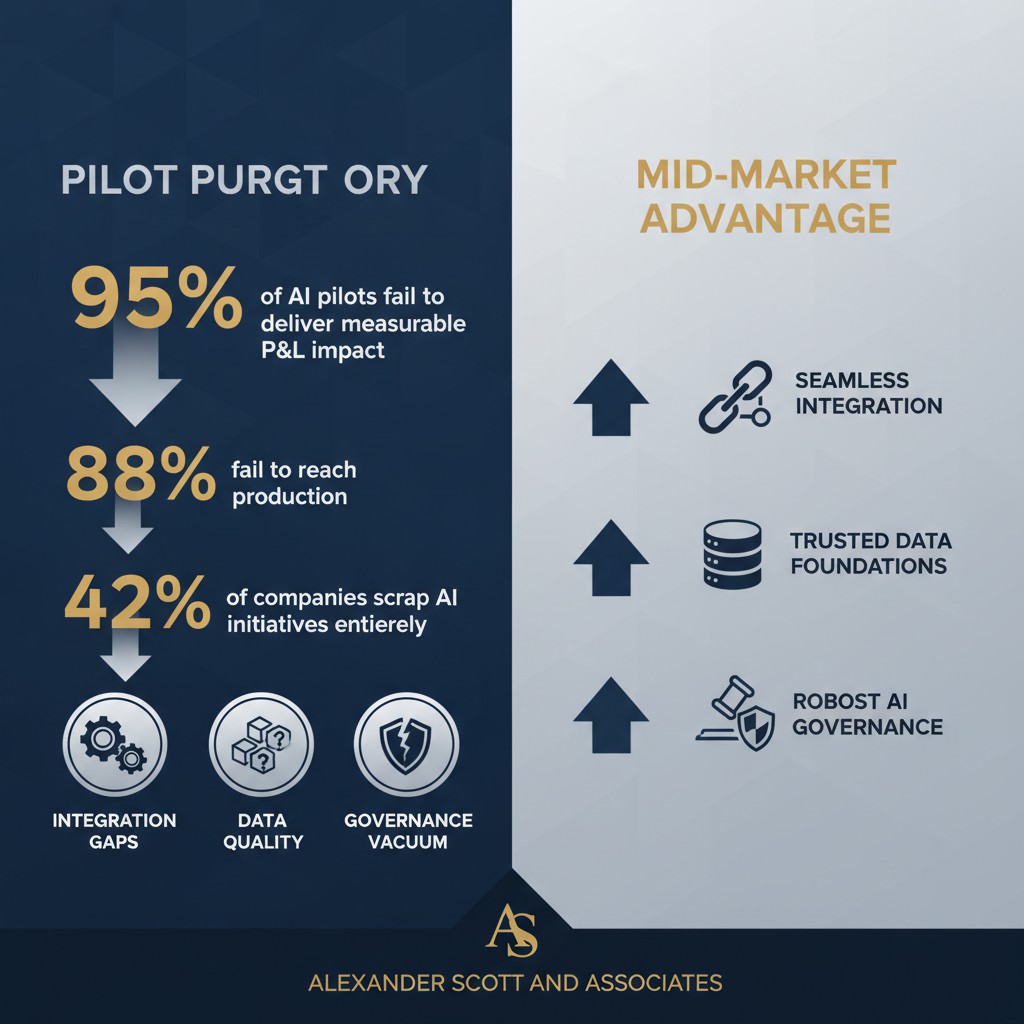
The Problem – Why 95% of AI Pilots Fail
What Is “Pilot Purgatory” and Why Are You Stuck There?
We’ve analyzed the data from MIT, McKinsey, BCG, and over 70 other sources. The findings are unanimous.
The failure isn’t technical—it’s organizational. Your experiments stall because of five critical, and predictable, gaps:
1. Integration Gaps
An MIT 2025 study found 95% of failures are due to integration, data, and governance gaps—not the AI models themselves. The pilot works beautifully in a clean “sandbox” but breaks the moment it touches your real-world workflows.
2. Data Quality Crisis
Only 1% of enterprise data is actually incorporated into AI models, according to Information Week 2025. Your messy, siloed, and incomplete data result in unreliable and useless AI outputs.
3. Governance Vacuum
Seventy-one % of mid-market executives admit they lack clear AI policies, according to KPMG’s 2024 report. There’s no clear ownership, no risk management framework, and no accountability.
4. Organizational Silos
74% of companies report that their business, IT, and data science teams operate in total isolation from one another. Technical success does not equal deployment.
5. Change Management Failure
BCG research reminds us that 70% of all major change programs fail, primarily due to employee pushback and a lack of buy-in.
The Hidden Cost of Pilot Purgatory
The cost isn’t just wasted time and budget; it’s also a significant financial loss. It’s massive opportunity cost.
- BCG found that companies that successfully scale AI achieve 3x higher revenue impact (up to 20% of revenue) and 30% higher EBIT than their pilot-stage competitors.
- McKinsey estimates the potential of Generative AI at $2.6-$4.4 trillion per year—but only for those who actually deploy it.
While you’re testing, your competition is scaling
The Opportunity – The Mid-Market Advantage
Why Mid-Market Companies Are Winning the AI Race
It’s tempting to think you’re at a disadvantage against enterprises with billion-dollar AI budgets. The research shows the exact opposite.
An MIT report on the “GenAI Divide” found that mid-market companies moved “faster and more decisively” than their enterprise counterparts. Your agility is your superpower.
Evidence-Backed Advantages:
- Agility Over Bureaucracy: You can implement a new solution in weeks, not quarters.
- Direct C-Suite Access: Your CEO, COO, and CTO can align on strategy in a single one-hour meeting.
- Less Legacy Complexity: You have fewer entrenched, decades-old systems and less technical debt.
- Focused Resources: You concentrate your budget and talent on the 1-2 highest-ROI use cases.
Key Stat: Growing SMBs invest 78% more in AI than declining firms, and 67% of mid-market leaders are investing in AI specifically for productivity gains (KeyBank 2025).
To win, you must adopt this mindset shift:
- AI is NOT an IT project; it’s a business transformation.
- AI is NOT a science experiment; it’s a product to be managed.
- AI is NOT just a vendor solution to buy; it’s a capability to build.
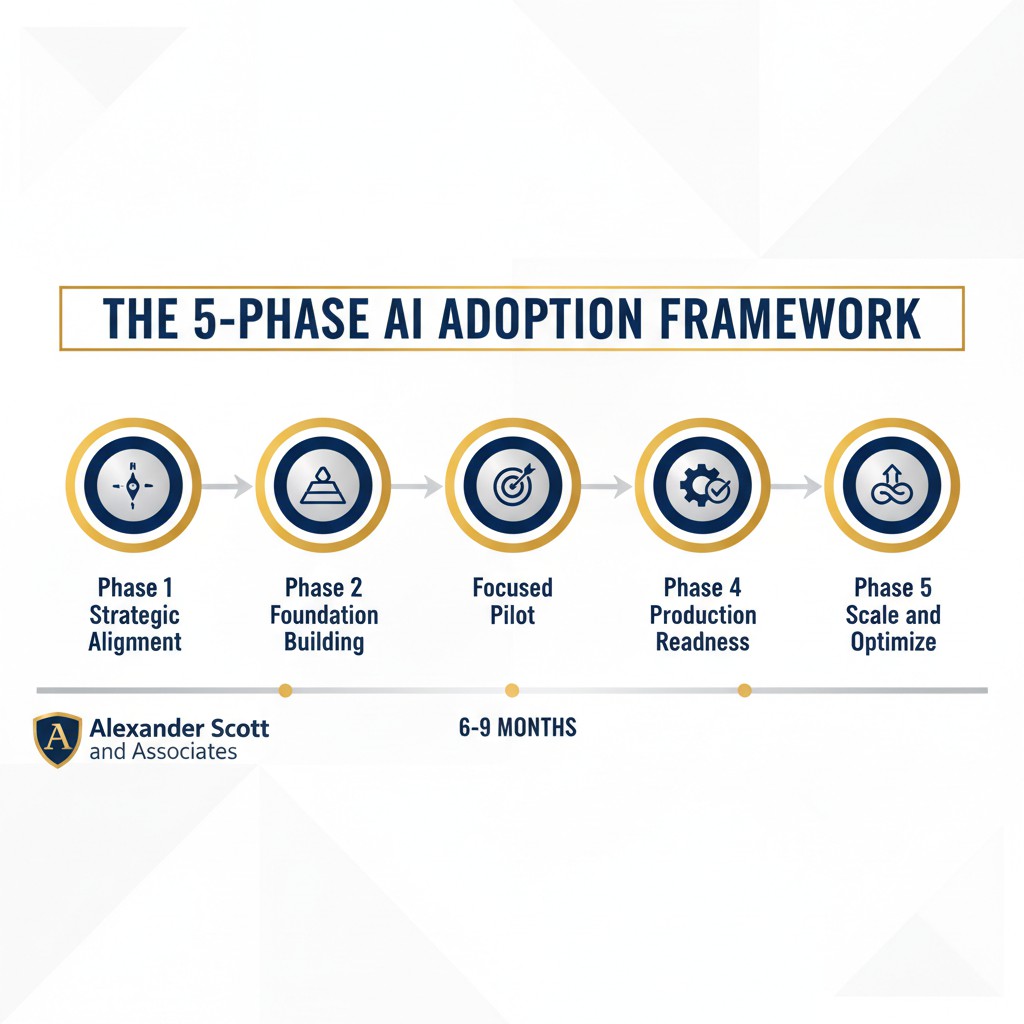
The Solution – The 5-Phase Playbook
The Proven 5-Phase Playbook: From Pilot to Production in 6-9 Months
This isn’t theory. This framework is a synthesis of over 15 methodologies from McKinsey, BCG, Gartner, MIT, and Forrester, specifically adapted for mid-market speed. While enterprises take 12-24 months, you can execute this in 6-9 months.
The key principle: Each phase is a gate. You do not advance to the next phase until the success criteria are met. This stops bad projects early and fuels winning projects.
PHASE 1: Strategic Alignment (Weeks 1-3)
Align Pilots to Business Goals, Not Technology Trends
Goal: Ensure every dollar spent on AI is directly tied to a measurable P&L outcome.
Key Activities:
- Identify High-Value Use Cases: Score every potential idea using the formula: Value × Feasibility × Risk.
- Define Success Metrics BEFORE Starting: Set your KPIs upfront, not retroactively.
- Secure Executive Sponsorship: An executive from the business side must own the business outcome.
- Baseline Current Performance: You cannot prove ROI if you don’t know your starting point.
Timeline: 2-3 weeks
PHASE 2: Foundation Building (Weeks 4-9)
Build the Infrastructure and Governance Foundation
Goal: Lay the groundwork so your successful pilot can actually reach production without hitting a wall.
Key Activities:
- Data Quality Assessment: Audit your data for completeness, accuracy, and consistency.
- Establish Lightweight Governance: Create a 2-4 person stewardship team that meets monthly to ensure effective governance.
- Define Use Case Boundaries: Create an “AI Contract” document.
- Build a Cross-Functional Team: Business Sponsor, Product Manager, Data Engineer, ML Engineer, SME.
Timeline: 4-6 weeks
PHASE 3: Focused Pilot Execution (Weeks 10-21)
Run a Time-Boxed, Production-Ready Pilot
Goal: Validate the business impact with a pilot that is designed to scale from day one.
Key Activities:
- Start with one high-value use case: resist the urge to run multiple parallel pilots.
- Time-Box Execution (8-12 weeks max): A hard deadline prevents scope creep.
- Build in a Production-Like Environment: Integrate with real systems, not an isolated sandbox.
- Focus on Business Metrics: Prioritize business metrics over technical metrics.
Timeline: 8-12 weeks
PHASE 4: Production Readiness (Weeks 22-29)
Industrialize for Scale, Reliability, and Support
Goal: Transform your successful pilot (Proof of Concept) into an enterprise-grade, reliable system (Proof of Value).
Key Activities:
- Build Scalable Data Pipelines: Automate data ingestion, validation, and transformation to streamline data processing.
- Implement MLOps: Model versioning, automated retraining pipeline, CI/CD for deployment.
- Establish Monitoring: Create real-time dashboards to track model performance and business KPIs.
- Execute Change Management: Begin role-specific user training and build a champion network.
Timeline: 6-8 weeks
PHASE 5: Scale and Continuous Optimization (Weeks 30+)
Expand Incrementally with Continuous Learning
Goal: Scale the proven solution across the organization while continuously improving its performance and value.
Key Activities:
- Use an Incremental Rollout Strategy: Roll out in phases by department, geography, or function.
- Monitor Adoption and Feedback: Track adoption rates by user segment to inform future decisions.
- Schedule Model Retraining: Regular retraining using new production data.
- Capture and Share Wins: Calculate final ROI and communicate across the organization.
Timeline: 8-12 weeks for initial scaling; ongoing
Evidence: Companies that reach this scaling phase achieve 3x higher revenue impact and 30% higher EBIT (BCG).
Real-World Proof: Manufacturing Case Study
Company Profile:
- Precision manufacturing firm
- 280 employees, $45M annual revenue
- Challenge: 18 months stuck in pilot purgatory. 8 disconnected AI pilots, $420,000 invested, zero production deployments.
The Turning Point:
We killed all eight pilots. Started over with the 5-phase playbook.
Results (After 12 months):
- Unplanned downtime reduced from 180 to 75 hours (58% reduction)
- Maintenance parts & labor savings: $95,000
- Avoided critical failures: $250,000
- Production throughput increase: $200,000
- Total Year 1 Value: $545,000
- Breakeven: Month 13
“We wasted 18 months and $420K treating AI like a science experiment. Following this playbook, we had a solution in production within six months and achieved a positive ROI just after the one-year mark. We stopped guessing and started executing.”
- CEO, Precision Manufacturing Firm
Why This Playbook Works Especially Well for You
Unlike enterprises, you have what matters most:
- Speed: You move in weeks, not quarters.
- Agility: You can pivot based on new data without a six-month review.
- Focus: You’re forced to prioritize high-ROI projects.
- Access: You have a direct line to the C-suite.
- Culture: You can transform a 300-person company far easier than a 30,000-person one.
What You DON’T Need:
✗ A large team of Ph.D. data scientists
✗ A multi-million-dollar “AI Center of Excellence”
✗ Perfect, 100% clean data before you start
✗ To build custom, from-scratch models
✗ A 2-year timeline
What You DO Need:
- A clear business objective
- An executive sponsor who owns the outcome
- To start small and prove value
- Cross-functional collaboration
- The discipline to follow this proven playbook
“You don’t need a massive data science team. You need a solution that addresses a specific, expensive bottleneck. Prove the value, then scale strategically.”
- Wilts Alexander
Breaking Out of Pilot Purgatory: Your 30-Day Action Plan
You can start this today.
Week 1: Audit Current State
- List all current and past AI pilots.
- Action: Formally KILL any pilot not on a clear path to production in the next 90 days.
Week 2: Strategic Alignment
- Run a 2-hour prioritization workshop with your leadership team.
- Action: Select your ONE high-value use case. Define its success metrics and assign a business-side executive sponsor.
Week 3: Foundation Assessment
- Audit the data quality for that single use case.
- Action: Establish your 2-4 person governance team.
Week 4: Build Your Roadmap
- Map out a detailed 6-9 month roadmap based on the 5 phases.
- Action: Secure the budget and form your cross-functional team.
The Decision
You have two choices.
Choice 1: Stay in Pilot Purgatory
- Continue running disconnected experiments.
- Deliver no measurable business value.
- Watch your competitors scale while you test.
- Ultimately, lose your AI budget and board-level confidence.
Choice 2: Follow the Proven Playbook
- Kill the “zombie” pilots.
- Execute a systematic 5-phase framework.
- Deliver measurable ROI in 6-9 months.
- Build a lasting, scalable AI capability.
The companies winning with AI aren’t more innovative, and they aren’t just better funded. They are more disciplined. They are following a playbook.
Ready to Break Free from Pilot Purgatory?
The AI revolution is here. However, 95% of companies remain on the sidelines, watching as a small group captures a massive, compounding competitive advantage.
The difference isn’t luck. It’s following a proven playbook that treats AI as a business transformation, not a technology experiment.
Your mid-market agility is your greatest asset. While enterprises are bogged down in bureaucracy,
You can move from a pilot to scaled production in 6-9 months.
The question isn’t whether AI will transform your industry. The question is whether you will lead that transformation or scramble to catch up.
- TAKE ACTION NOW: Contact Wilts Alexander https://calendly.com/coachwiltsalexander/30min
■ Download the Full AI Adoption Playbook
Get the complete implementation guide, including the Detective App:
- 5-Phase Roadmap Template
- Use Detective App
- AI ROI Calculator Template
- Production Readiness Checklist
Schedule Your AI Strategy Session
Book your complimentary 30-minute AI Adoption Strategy Session with Wilts Alexander. In 30 minutes, we’ll:
- Assess your current initiatives
- Identify your single highest-value use case
- Map out your 6-month roadmap from pilot to production
The playbook is here. The opportunity is now.
Executive Leadership Coaching & Strategic Transformation + AI